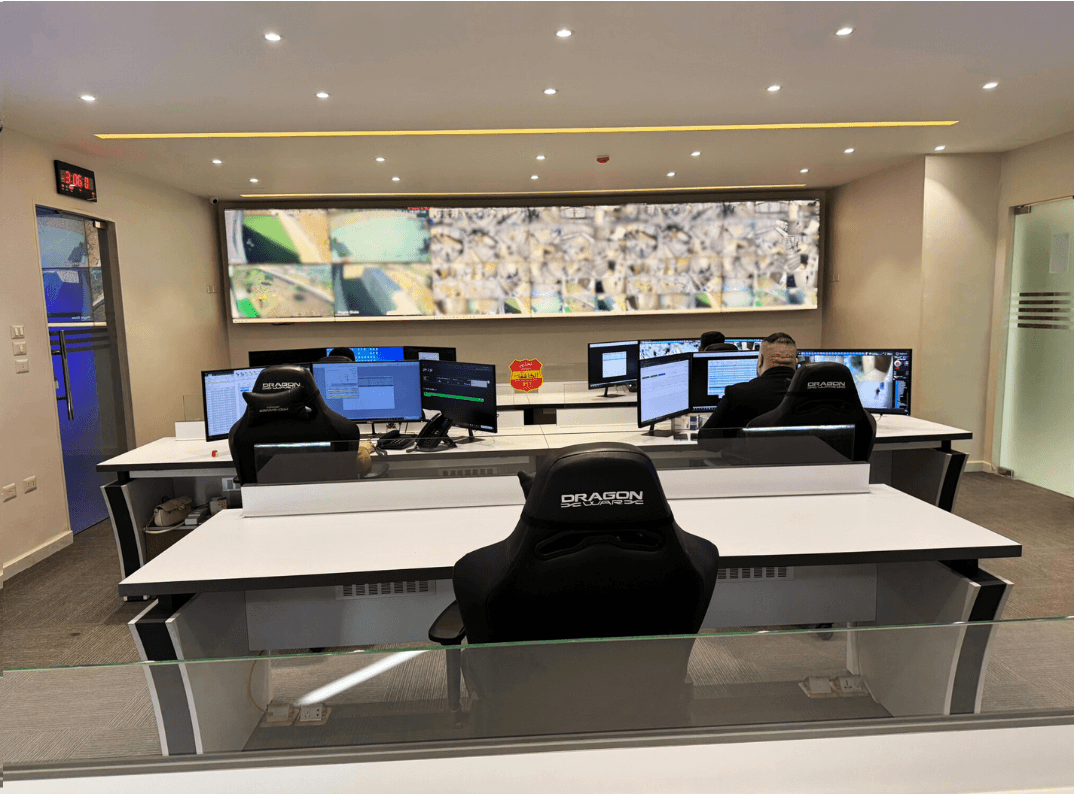
The Control Room is the mastermind behind any major security ecosystem. At Alkashef Al-Sareea, we provide Central Monitoring Station (CMS) Design services for large enterprises, shopping malls, banks, hotels, hospitals, and government and sovereign entities, transforming empty spaces into intelligent operations centers that support decision-making and provide complete control over all sites and systems.
What is a Central Monitoring Station (CMS)?
It's the nerve center where all security information from various systems and locations converges in one place:
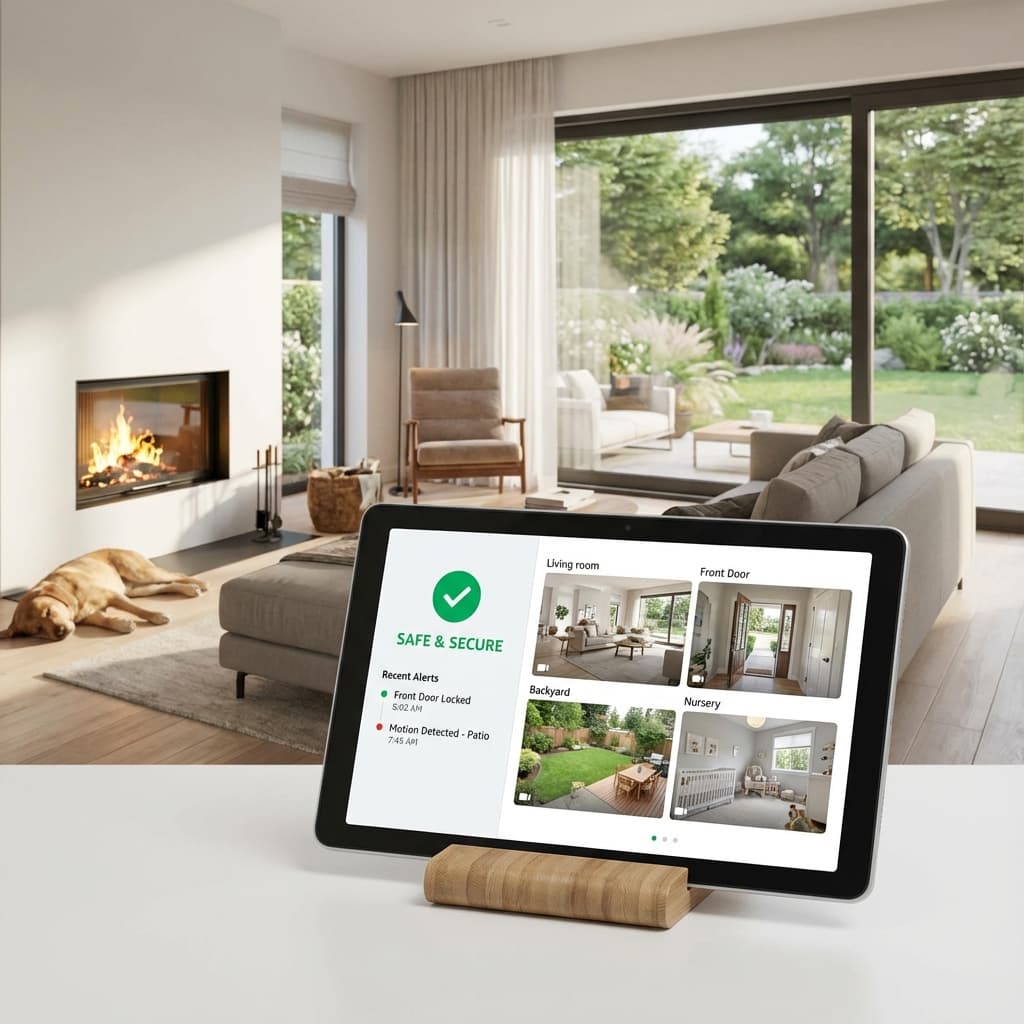
- CCTV Cameras: Live feed from tens or hundreds of cameras distributed across the facility or multiple branches.
- Alarm Systems: Theft, fire, and access control alerts.
- Access Control: Monitoring employee and visitor movement through entry points.
- Infrastructure Systems: Elevators, generators, HVAC systems, and more.
Operations Room Engineering: Beyond the Screens
Designing a successful monitoring station isn't just about hanging screens on walls; it involves precise engineering standards we follow based on global standards like ASIS and PSA:
1. Ergonomics
Designing operator workstations (Consoles) with scientifically calculated viewing angles:
- Viewing Angle: Main screen within 30° of the operator's horizontal line of sight.
- Desk Height: Adjustable to suit all employee heights.
- Seating: Comfortable chairs designed for extended sitting with back and neck support.
- Strain Prevention: Reducing eye and neck strain, significantly increasing attention levels during long shifts.
2. Video Wall Design
The main wall displays critical information needed by all operators simultaneously:
- Central Screens: Display the most important events (active alarms, ongoing incidents).
- Interactive Maps: Geographic distribution of sites and cameras.
- Statistics Dashboards: KPI indicators and system status.
- Technology: 4K LCD/LED screens with narrow bezels to minimize gaps between displays.
3. Optimal Work Environment
- Ambient Lighting: Balanced light distribution preventing screen reflections and reducing eye strain.
- Sound Insulation: Preventing external noise and interference between operators during sensitive reports.
- Climate Control: Optimal temperature and humidity for equipment and personnel.
- Restricted Access: Security door with access control preventing unauthorized entry.
Reliability & Business Continuity (Failover & Redundancy)
In security, every second counts. Therefore, we integrate solutions that ensure zero downtime under any circumstances:
Redundant Servers
If the primary server fails, operations automatically switch (Automatic Failover) to a backup server without losing a single second of live feed or recordings.
Hybrid Storage Solutions
- Local Storage: Large-capacity hard drives (RAID Arrays) for fast recording and instant access.
- Cloud Storage: Automatic daily backup ensuring recordings are never lost, even in disaster scenarios.
Power Security
- Online UPS: Provides clean, continuous power with automatic switchover during outages.
- Backup Generator: Activates automatically within 10 seconds of main power failure.
- Power Monitoring: Instant alerts for any power system anomalies.
Integration & Automation: A Smart Control Room
We don't just collect systems in one place; we intelligently connect them:
- Alarm-Camera Linking: When a theft alarm triggers, cameras from that zone automatically pop up on the operator's screen.
- Smart Automation: Programmed rules that execute automatic actions (like locking specific doors, activating emergency lighting).
- Third-Party Integration: Connection with ERP, HR, and attendance systems.
AI Integration & Scalability
Our designs support Scalability; you can start with 50 cameras and scale up to 5000 cameras without needing to restructure the entire room. We also support the integration of advanced video analytics:
- Facial Recognition: Identifying individuals on watchlists.
- Crowd Detection: Alerts when an unusual number of people gather.
- Behavior Analysis: Detecting suspicious behaviors like running or falling.
- License Plate Recognition (LPR): Automatic logging of all entering and exiting vehicles.
Project Implementation Phases
- Requirements Study: Understanding client requirements, facility size, and number of locations.
- Engineering Design: CAD drawings for the room and electrical/network infrastructure.
- Equipment Selection: Recommending best brands compatible with budget.
- Installation & Integration: Professional implementation with comprehensive testing of all systems.
- Training: Qualifying the operations team on using all systems.
- Support & Maintenance: Periodic maintenance contracts and 24/7 technical support.
Frequently Asked Questions About Control Room Design
What space is required for a control room?
Depends on the number of operators and video wall size. As a rule of thumb: 4-6 square meters per operator, plus space for equipment and maintenance.
How much does it cost to build a central monitoring station?
Costs vary significantly based on size and requirements. A small room for a medium company might start from 10,000 JOD, while an operations room for a large mall or government entity could exceed 100,000 JOD.
Can an existing control room be upgraded?
Absolutely! We provide upgrade and modernization services for existing control rooms, whether adding new systems, replacing old equipment, or improving engineering design.
We build operations rooms that don't just watch; they provide you with total control and protect your investments using the latest global security technology.
Need a central control room for your facility? Contact us today for a free consultation and preliminary study of your requirements.